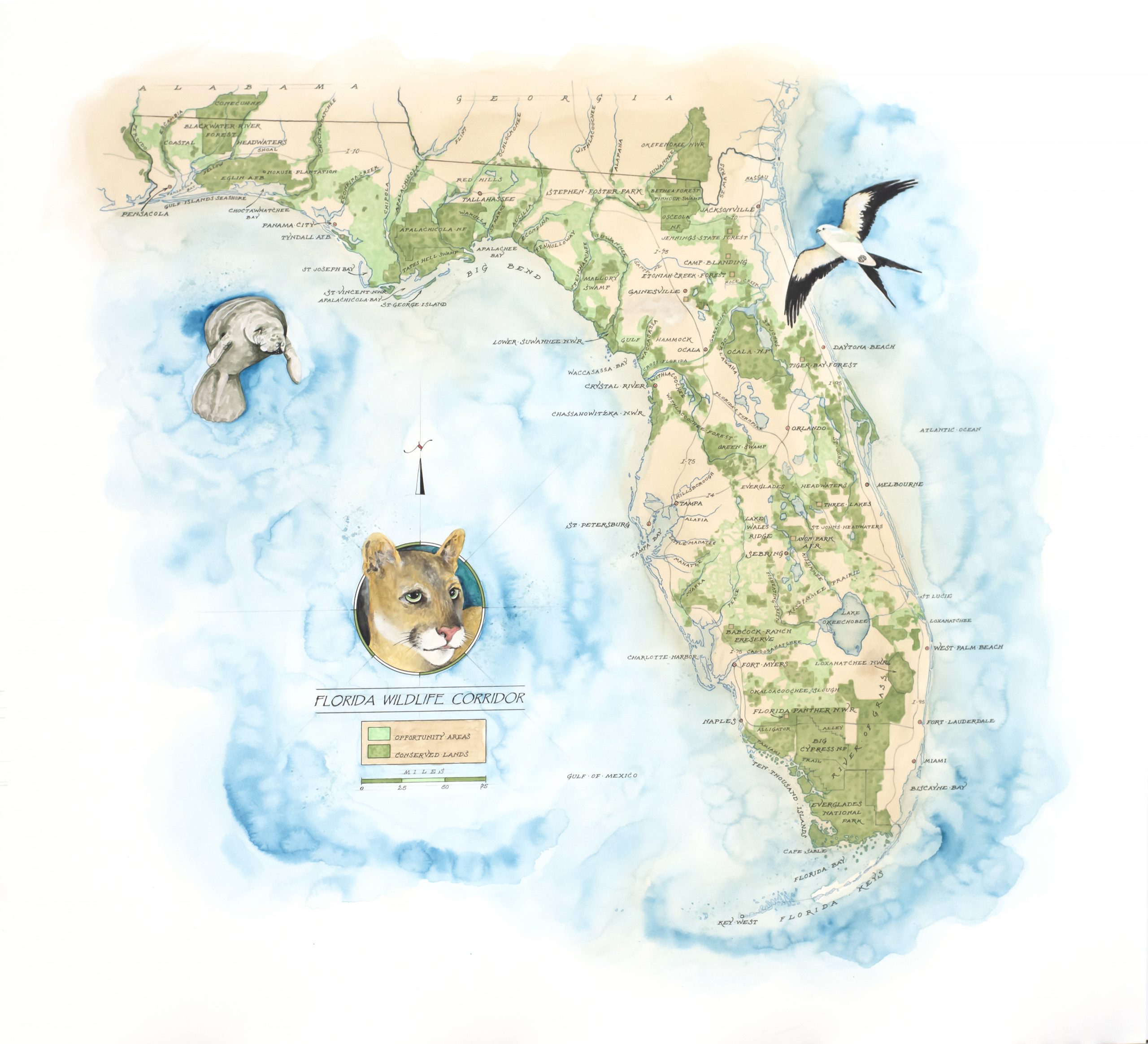
The new Design Guidelines for Corridor Compatible Communities outline best practices for developing new communities near the 18-million-acre Florida Wildlife Corridor to support the habitats and connectivity needed to protect Florida’s wildlife. While focused on large master-planned communities, guidelines in the 153-page book can also be applied to urban areas, even those as developed as Pinellas County, the state’s most densely populated county.
“There is one guideline that everyone in the state, if they’re looking at their property as a piece of the natural system, can follow: plant Florida native plants and create habitat, not just decorate their home with landscaping,” said Rebecca Bradley, founding principal of Cadence, the landscape architecture firm that authored the design guideline document published by the Florida Wildlife Corridor Foundation. “Otherwise, we’re just planting sod, and that has a huge impact in our state because of all the single-family homes.”
Even urban areas can support wildlife using the core principles of the corridor guidelines:
- Biodiversity by protecting or creating natural systems that support a wide variety of species
- Resilience by protecting and mimicking natural systems that resist damage and recover from climate hazards like hurricanes
- Connection by prioritizing ways for wildlife to move, find mates and then disperse while minimizing habitat fragmentation.
“Our yards may not be as big, but we can create ‘microscapes’ inside urban settings,” she said. “This is key – we can rewild urbanity, and we can also create communities that are compatible with our rural and natural areas. We really do need both of these things in our state, and there are many things in this document for urban communities to utilize, and for homeowners’ associations to think about, that will contribute something positive to our environment.”
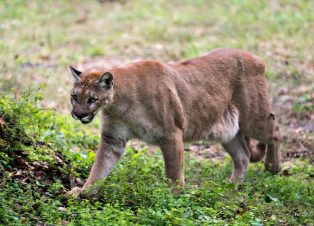
The Florida Wildlife Corridor, a series of lands and waters preserved in large part to create the connections that will allow the Florida panther to survive into the future, runs from the Everglades to the Panhandle. It largely sweeps around most of the Tampa Bay region, focusing on areas to the south, east and north, although multiple panthers have been sighted in east Hillsborough County, where the guidelines could be used to develop new communities.
At the current pace of development, Florida is converting more than 120 acres every day from ranchlands and pine forests to rooftops and roads, so action is needed quickly. The goal of the Florida Wildlife Corridor Foundation is to show that many examples of development could use the guidelines. With sufficient local implementation, the Foundation would consider establishing a certification program similar, to the LEED rating system that provides a framework for energy-efficient and healthy buildings, Bradley said. “The thought is for us to credential professionals, not just projects, so that those of us in the engineering and planning fields could be certified as a professional who understands corridor compatibility.”
The first major application of the guidelines is a development project in Volusia County currently moving through the planning and design process. “It’s been approved, so we can dive in with the developer’s team, and they can run through the qualities,” Bradley said. “We’ll soon begin to score the design in a back-and-forth conversation as the developer and those municipalities and agencies work to bring the project online.”
Work on the guidelines started in 2022 during breakout sessions at the Corridor Connect Summit convened by the Florida Wildlife Corridor Foundation. “We wanted a single point where people could see what we could do in the realm of best practices and design guidelines when we see development next to the corridor,” Bradley said. “About 65 people gathered and began to co-author the document, including folks from agencies, land-use attorneys, developers, planners, landscape architects and conservationists.”
Five different technical advisory committees worked on the guidelines for 18 months, revising and retooling them based on comments from the diverse groups involved in the discussions. “Years and years of research and science-based landscape ecology principles show that saving functional natural landscapes is what will make us able to execute responsible design spaces for the humans that are going to keep coming to our state,” Bradley said.
Responsible development isn’t a new goal, she adds, but the clarity of the Corridor Compatible Communities document will ensure that biodiversity, resilience, and connection are being achieved in new development, and provide a roadmap to achieve those goals.
By Vicki Parsons, originally published Dec. 8, 2025