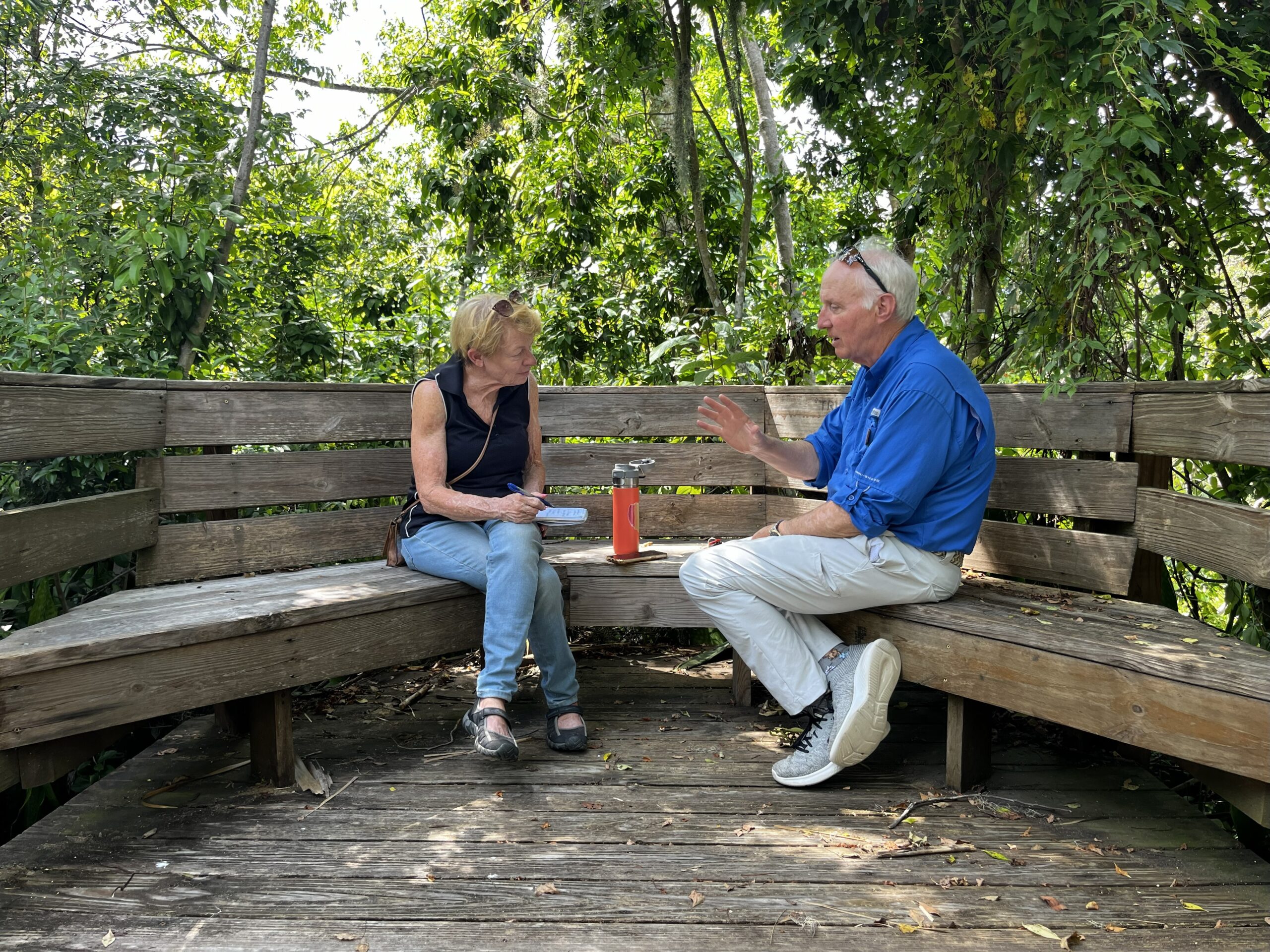
Charlie Hunsicker built his career on being in the right place at the right time – and everyone in Tampa Bay has benefited. Now the director of natural resources for Manatee County, Hunsicker earned the 2025 Herman W. Goldner Award, the highest award bestowed on an individual for regional leadership at the Future of the Region Awards presented by the Tampa Bay Regional Planning Council (TBRPC).
“Charlie has been at the forefront of environmental protection in the Tampa Bay region for nearly 50 years,” said Wren Krahl, TBRPC’s executive director. “His work has impacted every resident in Manatee County and Tampa Bay, as well as across the state and nation as a leader in purchasing environmental lands for preservation.”

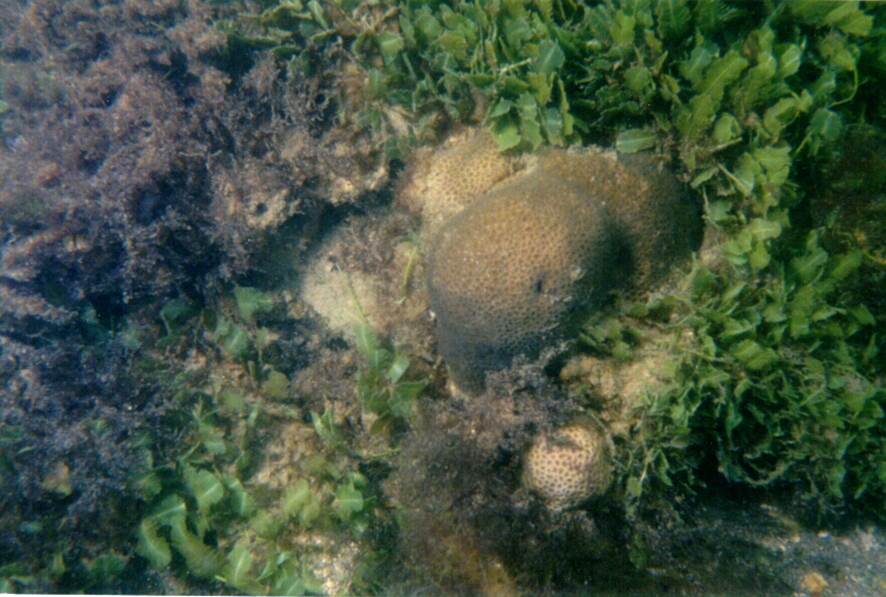
It all started in 1982 when he was working in Manatee County’s utilities department. At the time, the U.S. Army Corps of Engineers was deciding where it would dump spoil material from deepening and widening the Tampa Bay ship’s channel. “The EPA, with limited information, designated an interim disposal site approximately 9.5 miles from shore – just outside the 9-mile limits of the state’s jurisdiction and review authority – but was moving so slowly to designate a final site that the Corps decided to use it without the complete study,” Hunsicker recalls. “So by moving to use the interim site, the Corps failed to complete the studies which would have indicated irreversible impacts to the rare living hardbottom in the immediate area.”
Then, required testing revealed that the sediments to be dredged were contaminated with Vibrio cholerae that can cause severe diarrhea. “They were going to put that 9.5 miles off Anna Maria Island. We went through the normal administrative notices to challenge the site, and finally concluded that ‘the only way we’re going to get past this is to go to court.’”
The county eventually prevailed in December 1982. As a result of the trial, spoil areas in all 50 states are subject to a new standard of review between the Corps and the EPA. “I got to be the county’s environmental guy and it was a wonderful, expansive experience of what I could do, working with the best people to make a real difference.”
That experience came in handy two years later when the county applied for a $51 million grant from the EPA to build new wastewater treatment plants. “The application was submitted during the last year that federal grants for up to 75% of the cost of infrastructure were available. In the years that followed, only revolving loans, which had to be repaid, would be available,” he recalls.
“The head of the EPA’s Region IV office met with Manatee County to remind us that the award was a two-year grant with the first installment of $25 million, but that the remaining $25 million was dependent upon further congressional appropriations. We needed to commit to finishing the job with local funding – with or without additional federal grants. It was a substantial local funding gamble. We could have made a difficult decision to reject the grant with those conditions, but we didn’t.”
Then came the permitting war in 1985 with a phosphate company that owned thousands of acres a couple of miles upstream from the reservoir that provides drinking water for most of the county. “We did not have an anti-mining permit – we had mining regulations but they effectively said if the phosphate company can check off all the boxes, then they get the permit.”
As luck would have it, in the middle of the permitting battle, the phosphate industry hit a downturn, and the landowners decided they’d be better off selling the land. “Now, at that time, no one had local environmental land acquisition programs the way we do now, but we had to protect our drinking water and that resonated with voters,” Hunsicker said.
In 1986, voters approved funding to purchase the first section of what became Duette Preserve. When W.R. Grace, another large phosphate mining company, decided to sell 9,800 acres in the river’s watershed, the public expanded the preserve, and it did it again with a second referendum in 1988.
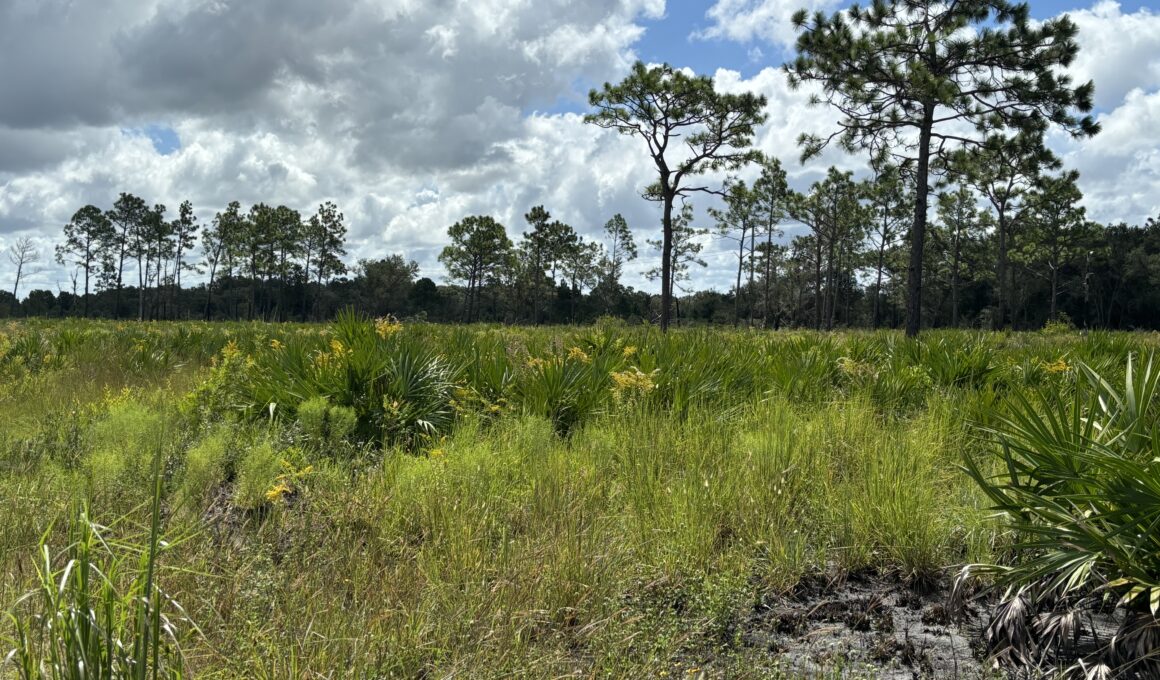
Although Manatee County didn’t have a formal environmental lands acquisition program until 2020, its Department of Natural Resources racked up significant wins in the years leading up to it through partnerships with the state’s Florida Communities Trust (FCT) before that, particularly as coastal farmlands became unproductive due to sea level rise and saltwater intrusion and became subject to intense development pressure.
“Let me –go down the list – Emerson, Creek, Robinson, Neal and Ungarelli preserves, plus Riverview Point adjacent to DeSoto and National Memorial – that’s six coastal properties that literally had development plans prepared and partially approved,” Hunsicker said. “With the public’s confidence and funding, we were able to change that destiny and keep them as environmental lands forever.”
We met at one of Hunsicker’s favorite spots in his favorite park, Emerson Preserve, in the shade of live oaks that survived the 2024 hurricanes. Even in the middle of summer, it was cool high atop a temple mound, built by Native Americans between 900 and 1700 as part of the Portavant Mound System, where a series of wooden boardwalks and decks led to the top of the mound. He’s passionate about protecting prehistoric sites, so a series of wooden decks leads to the top of the mound. It was important that improvements make the site more accessible to visitors without damaging the ancient structure.
“Before we put this in, people were driving their trucks up one side and going down the other so the mound was starting to erode. And I said, ‘This has been here 1,500 years, we are not going to lose it on my watch.’”
Further south, Robinson Preserve exists today as a wetland nursery for snook, after transitioning from coastal forest to agricultural land to restoration opportunity. could have been restored as coastal forest but that would have been unsustainable for the same reasons the land couldn’t be farmed, so they started from scratch and built wetlands to meet the specific needs of snook. “The original development plan called for 640 condominiums, a championship golf course and a residential community on 420 acres,” Hunsicker recalls. “We still didn’t have an environmental lands program, but we had some ideas working with state grants and local dedicated property tax funding.”
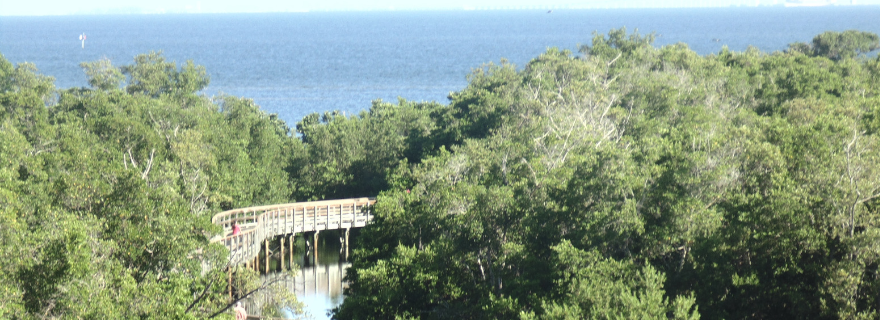
In 2012, Mosaic was interested in supporting Manatee County’s recreational infrastructure, such asand suggested building ball fields, when Hunsicker made a bold recommendation: recommended a donation to the newly established Conservancy of Southwest Florida (now Big Waters Land Trust) to purchase the second phase of Robinson Preserve, then donate the land to Manatee County. instead. Using that value of the foundation’s donation as matching funds, Hunsicker went on to persuaded multiple state and federal agencies to contribute $6 million in grants to rebuild the preserve specifically to provide habitat for fish like snook that need very specific low-salinity areas as juveniles. “The granting agencies could see the importance of that location to help build resilience for Lower Tampa Bay,” he said. “We went in with a simple formula: let Mother Nature reinvent herself on this landscape, and she did.”
At age 72 and after nearly 50 years in county government, the question of when Hunsicker plans to retire had to come up. “There’s always a challenge ahead – something that needs to be done next week, next month, or next year. And then to make matters worse, we always do these darn five-year CIPs (capital improvement plans) so I feel like I need to get everything done even faster.”
He says he has a 10-year plan for retirement but even his wife of 39 years questions that. “It’s kind of a moving plan, like a CIP that you update every five years. If you’re in the right place and you work hard and you have a wonderful team around you, and you have your supervisors and your board of commissioners holding the same vision, then you’re working in a place that’s not really a job.”
We’ll check back in 10 years, Charlie!