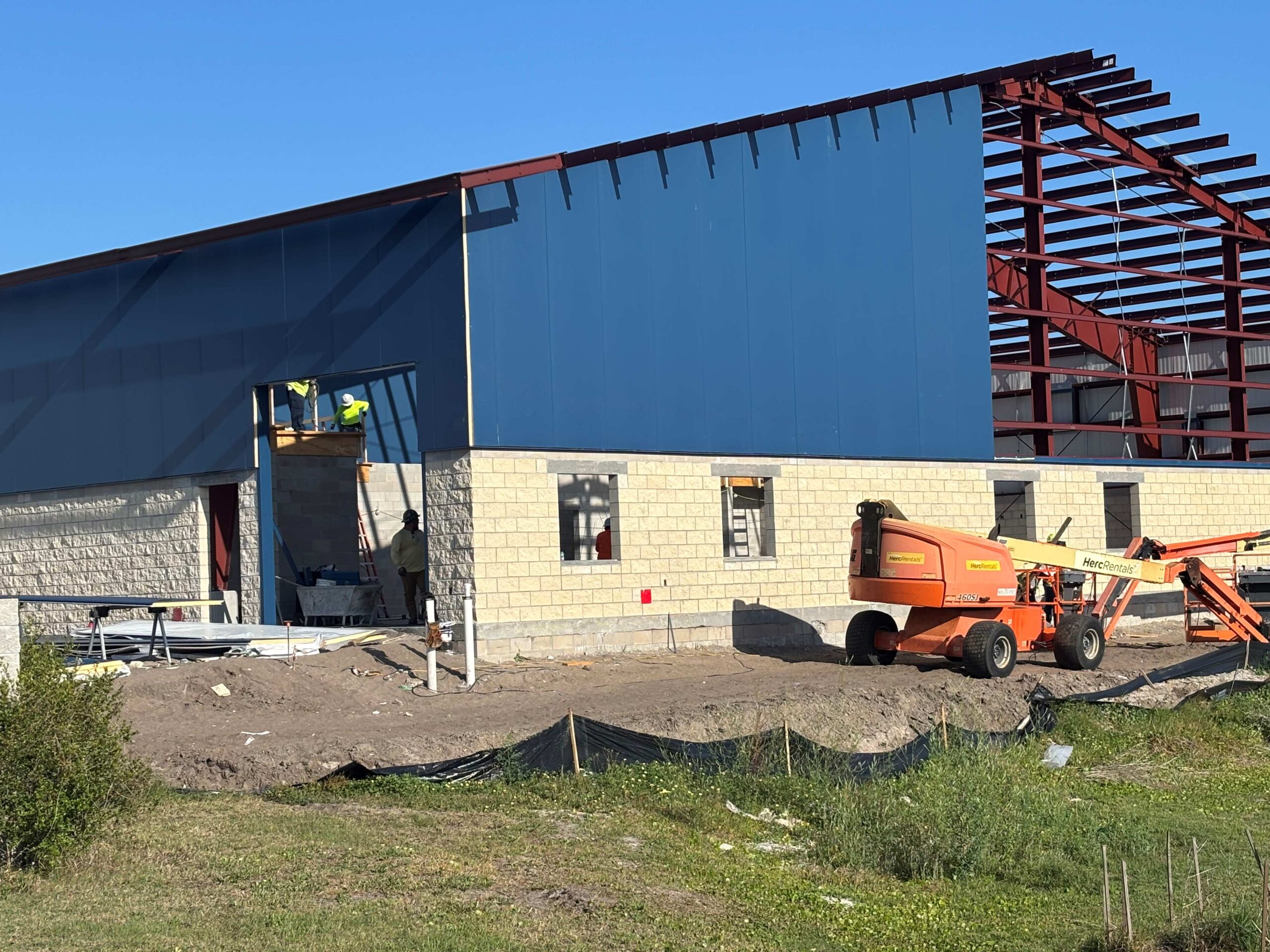
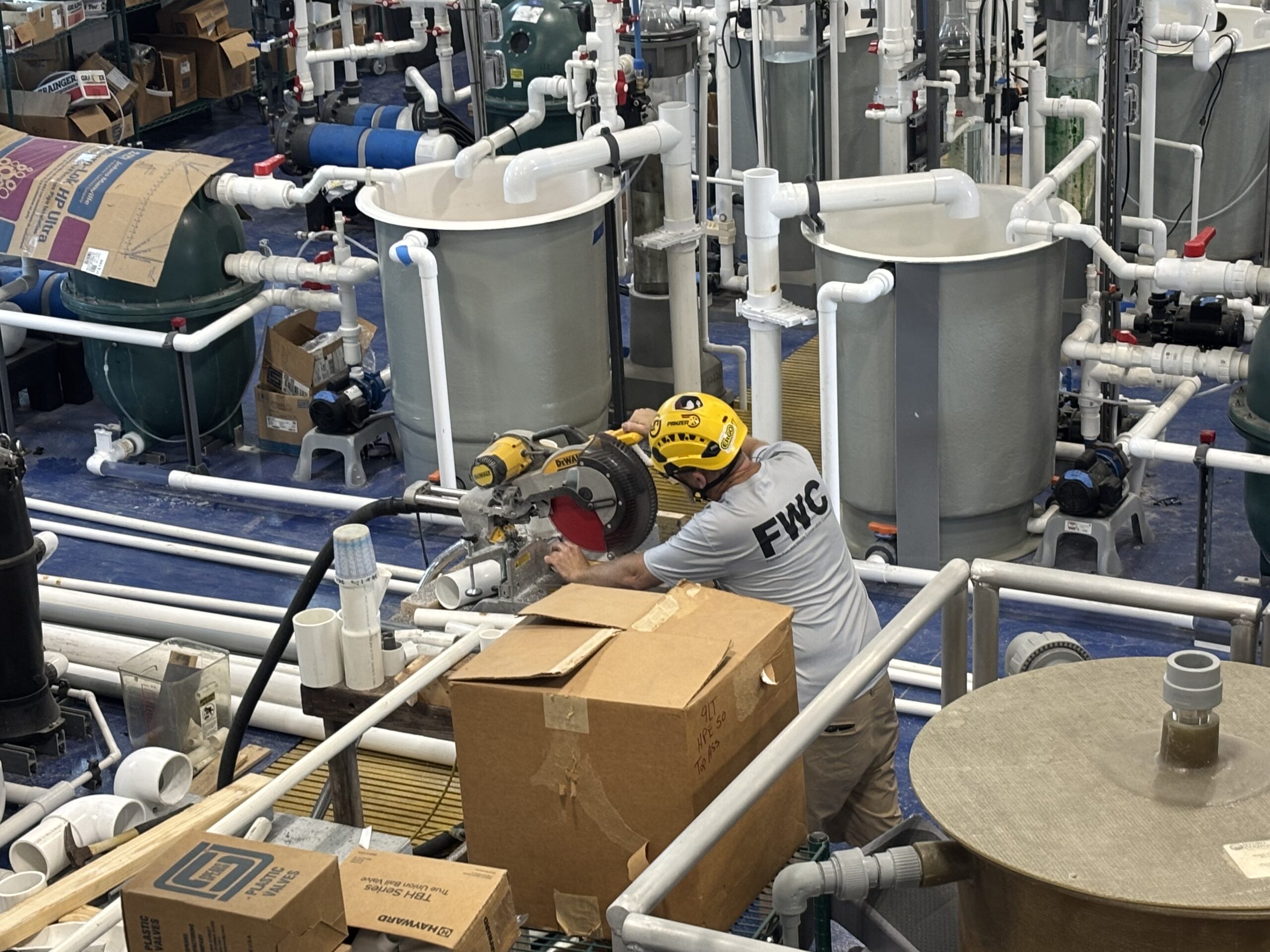
Any fisherman will tell you that getting out on the water doesn’t necessarily mean you’ll come home with fish. It takes knowledge, the right tackle and patience. The same is true for successfully releasing fish from a hatchery. It takes expertise, sophisticated equipment, and patience to build a 10,000-square-foot hatchery and then to know how to stock the right fish in the right place at the right time.
For Jason Lemus, research administrator for the Florida Fish and Wildlife Conservation Commission’s (FWC) new state-of-the-art hatchery at the Florida Conservation and Technology Center in Apollo Beach, the hard work is about to pay off. Construction is nearing completion now, and the facility is designed to produce up to a million fish if the science supports the practice.
He joined FWC in 2012, expecting to operate a research center to develop and document the best technologies to induce wild adult fish to spawn indoors, grow out the larva, release them into habitats, and then monitor their survival. Plans changed during the last major red tide bloom, and the Apollo Beach facility was reimagined as a hatchery to replace the production facilities at Port Manatee that had closed in 2020.
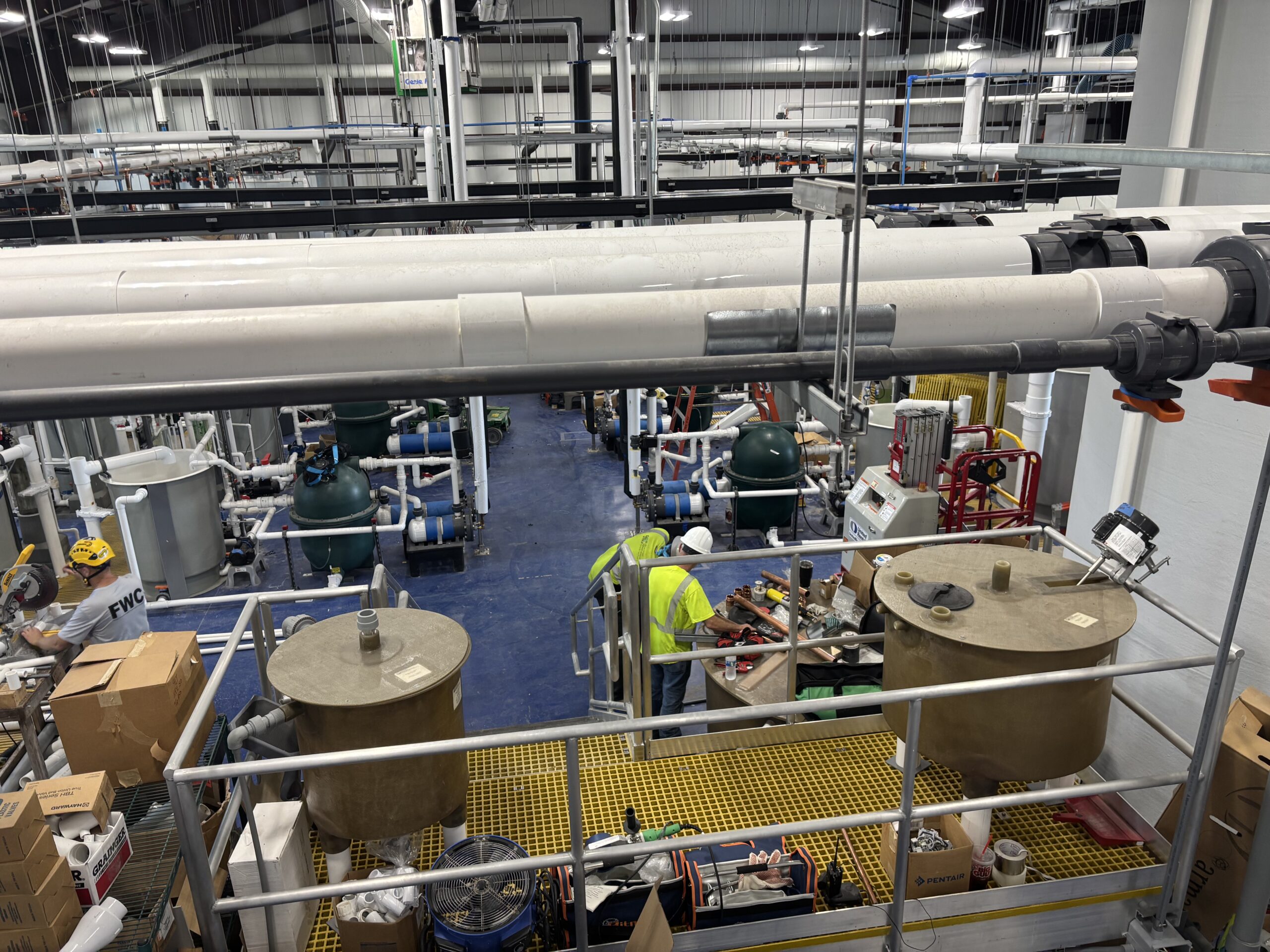
Prior to Lemus’s arrival at FWC, the fisheries and hatchery teams had learned the importance of stocking the right-sized redfish in the right places at the right time of year., Lemus said. “Our philosophy now is to stock fish in season so that the life history phase should match what’s happening in the wild. That means getting them out there with the right food to eat and the least amount of predation, or at least an amount of predation that they can avoid. We’ve gotten to be pretty good at it now, on the research scale we had been working with.”
Common snook, spotted sea trout and redfish are the species most targeted by inshore fishermen, Lemus notes. Snook are raised for stock enhancement at Mote Aquaculture Park by Mote’s Fisheries Ecology & Enhancement Program, so the Apollo Beach facility will focus on redfish and sea trout. “These coastal species stay pretty close to the areas where they are released. Their stock ranges are fairly narrow as well, with redfish stocks ranging as much as 200 miles. That means fish from Charlotte Harbor are very different from fish from Pensacola, and we’ll need to work with the right stock to be successful.”
The process starts when fishermen catch about 100 adult redfish in a purse seine net as they school during their fall spawning event. The goal is to catch 60 healthy fish to ensure genetic variability. They’ll be placed in one of the facility’s two 20-foot diameter production tanks for more than a year before they’re ready to spawn again. “We catch them in October when they’re congregating to spawn, but we need to wait a year until they really spawn well in hatchery tanks,” Lemus said.
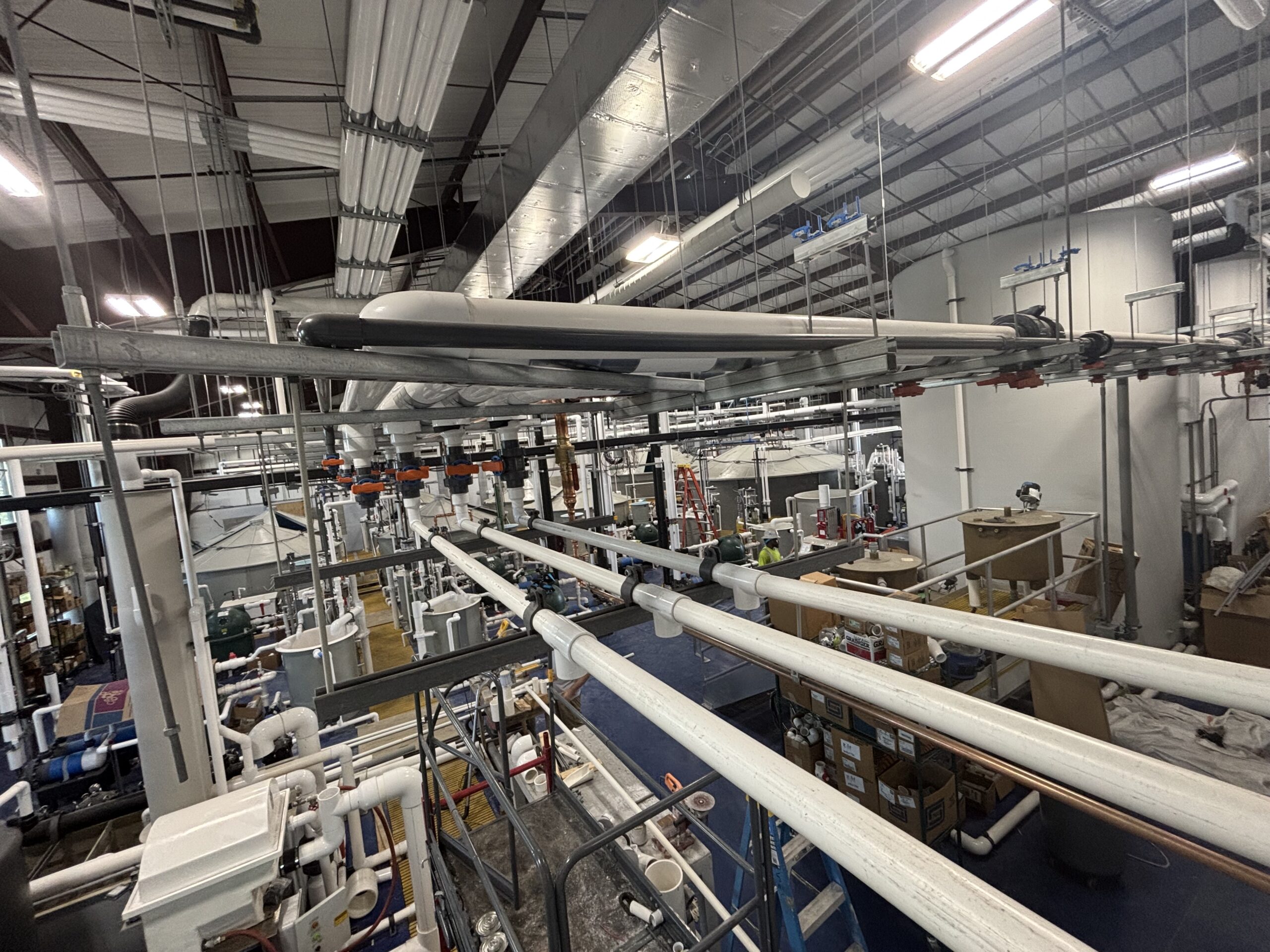
The larval phase is the most critical because the tiny animals are very delicate. Lemus and his team will grow food for them on site, including two types of plankton. Saltwater for the tanks comes from a 900-foot deep well within the Floridan aquifer to get saltwater that is close to natural seawater. “This far up the bay, the salinity is only about half of full-strength seawater. Plus, when you look around, you see all kinds of development that could impact the water quality.”
One innovation that will improve efficiency is a sweeping element on the bottom of the tank that slowly brushes across the bottom, pushing uneaten food and fish excrement into a small trough where it can easily be removed in minutes. “Previously, we had to vacuum the bottom of the tank which took more than an hour, and when these fish are tiny you have to move very slowly to prevent disturbing the fish and pushing the waste back into the water.”
The redfish larvae, which are about an inch long at 30 days old, are released at the same time wild fish achieve that size so that they don’t have a competitive advantage in limited habitats. “Ideally, we’d like to grow them out to four to nine inches, based on the research that’s been done by FWC,” he said. “Our research suggests that larger fish are more likely to survive, but growing larger fish requires larger tanks and more space than we have here.”
Releasing fish at 30 days is obviously much less expensive than raising them to eight or nine inches – which would take three to five months – but much fewer survive because there is more competition for resources when they are at that size. “It’s trial and error for them to learn to find food and shelter from predators, which they do not experience in hatchery tanks.”
After the fish spawn at the hatchery, adult males can be released, but the females, which have the genetic markers used to identify hatchery fish, cannot be returned to the wild where their offspring would be misidentified as hatchery fish.
Data from the FWC’s Fisheries Independent Monitoring program, which captures fish at various stages of their lives, will determine the long-term success of the hatchery fish. Over time, Lemus hopes to partner with other groups across the state in research and stocking collaborations, including universities that have graduate students and professors who want to do aquaculture research with redfish and spotted seatrout.