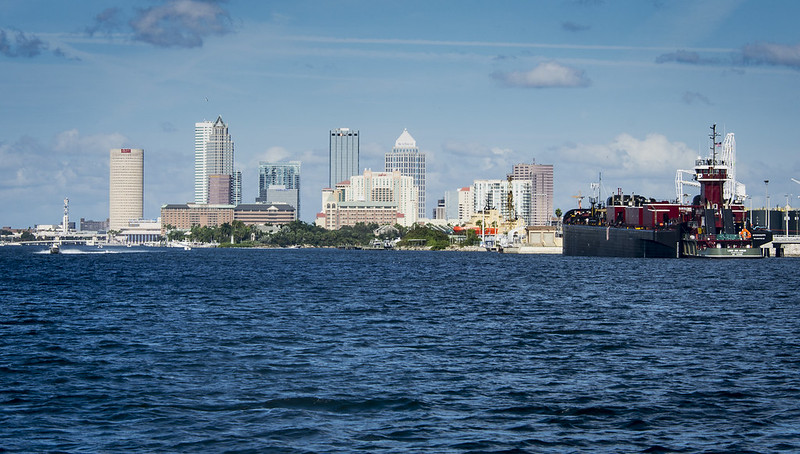
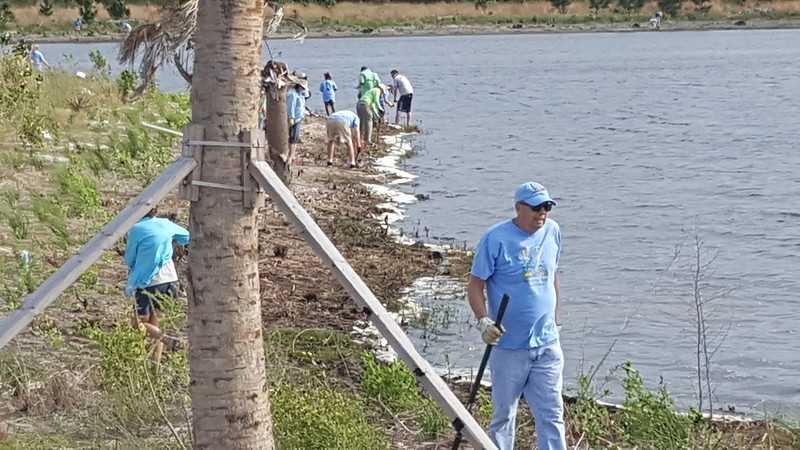
Forty years ago, following concerted efforts by residents troubled as water quality in Tampa Bay steadily declined, the Agency on Bay Management was officially created as part of the Tampa Bay Regional Planning Council (TBRPC).
Now known as the Agency on Bay and Coastal Management (ABCM) to reflect a more regional impact, the Agency celebrated its 40th anniversary with a reception at Tampa Bay Watch’s waterfront campus and a short video highlighting the people who have helped turn a bay once plagued by pollution into an international success story.
“Every year we had a blue-green algae bloom in Hillsborough Bay,” recalls Roger Johannson, who worked for the City of Tampa when its first advanced wastewater treatment plant was built in 1979. “It usually started in June or July and lasted all summer. The water in the bay was so green that it looked like a lawn.”
The push to clean up Tampa Bay had begun years earlier, with leaders like Betty Castor, Ernie Estevez and Robin Lewis protesting the pollution – particularly untreated or partially treated sewage – pouring into the bay. The formalization of the ABCM as part of the TBRPC was a turning point for Tampa Bay.
The state legislature, prodded by then Representative Mary Figg, created the Bay Study Group in 1976. “We spent a year or two doing a study of Tampa Bay — what the problems and needs were and then evaluating solutions,” said Sally Thompson, who had joined Save Our Bay, the first organization to protest pollution in Tampa Bay, in 1974 and has served on the ABCM since it was established.
“We came back with three recommendations. The first was to form an authority, which probably wasn’t going to be looked at very well by local governments, or people who didn’t want another layer of government. The second was an agency like the Area Agency on Aging, which we already had here. And the third was to do nothing. Well, obviously, one and three wouldn’t work, so that’s when the Agency on Bay Management was formed.”
At the time, the concept of regionalism was not always well-received because cities and counties were competing for growth, said Wren Krahl, TBRPC’s executive director. “But when it came to Tampa Bay, it was easy to explain to folks that we all have a stake in that beautiful body of water. I think one of the most important things about the ABCM is that we’re all working together – we meet with one purpose, and that is to be stewards of the bay.”
The ABCM is also unique in its membership, particularly for the times. Along with representing multiple governments, it brought a broad group of professionals together, from scientists and environmentalists to developers, fishing interests and the port authority. “The value of the Agency was having all those disparate parties in the same room. All these people, including the nature and conservation organizations that had had little voice outside of trying to get agencies to do the right thing, had equal seats at the same table,” Thompson said.
From that beginning, the ABCM was able to foster other organizations with different funding sources and regulations that were able to ultimately provide the framework for the bay’s restoration, including the Tampa Bay Estuary Program and the Southwest Florida Water Management’s SWIM (Surface Water Improvement and Management) program, said Peter Clark, a former ABCM staff who founded Tampa Bay Watch as a volunteer organization working to restore the bay.
“We started with an organization that didn’t have any jurisdictional responsibilities, but ultimately grew into other organizations and different entities that could take on a variety of different responsibilities so we could all work together to advance the ultimate goal of restoring Tampa Bay,” Clark recalls.
While Tampa Bay – as a region and as an estuary – is no longer a place where 60 Minutes can highlight the mistakes made as the community grew, there is still work to be done. “The mission is not over,” said Woody Brown, immediate past chair of the TBRPC and co-chair of the ABCM.
“The mission is not over,” Brown said. “We probably have 40 more years of work to do, fortunately or unfortunately, depending on your perspective. You know, the population continues to grow, so those impacts on Tampa Bay continue to change and intensify in some cases. Making sure that we don’t go backward will take the entire team working together.”
The quarterly ABCM meetings are open to the public. To learn more about the ABCM and its upcoming meetings, visit: https://tbrpc.org/about/services/environmental-planning/abcm/
By Vicki Parsons, originally published Oct. 1, 2025