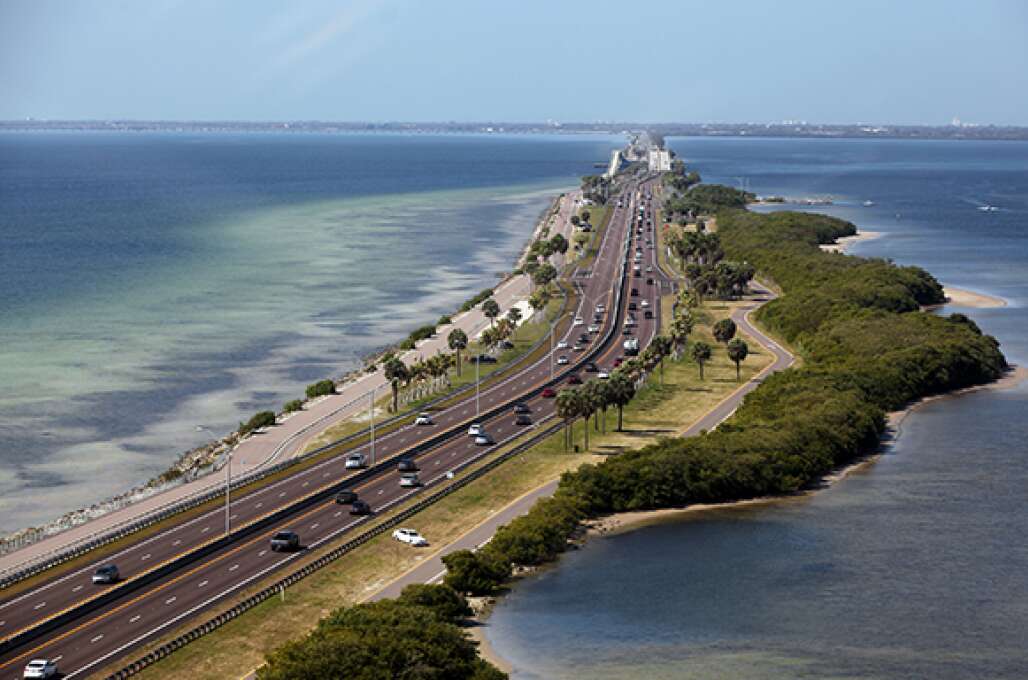
As the Florida Department of Transportation (FDOT) considers expanding the Courtney Campbell Causeway, environmental leaders are calling for a design that would increase tidal circulation in Old Tampa Bay. Long recognized as Tampa Bay’s “problem child,” Old Tampa Bay has less seagrass than ever before.
“The causeways restrict tidal flow allowing nutrients from a highly urbanized watershed to reduce water quality and stymie seagrass recovery in Old Tampa Bay,” said Ed Sherwood, executive director of the Tampa Bay Estuary Program. “We’re seeing toxic algal blooms nearly every summer, along with seagrass losses far exceeding any other bay segment. As plans are drawn for a new causeway, it presents a once-in-a-generation opportunity to improve tidal circulation and support overall restoration activities in this bay segment.”
That opportunity has broad backing from local governments as well as grassroots support. “We’re seeing a lot of engagement from our network,” said Justin Tramble, executive director of Tampa Bay Waterkeeper. “They understand that the causeway is essentially a dam that blocks normal flushing. We all appreciate FDOT’s desire to make the causeway safer and more efficient, and we hope that any modification can also improve a part of the bay that isn’t doing very well.”
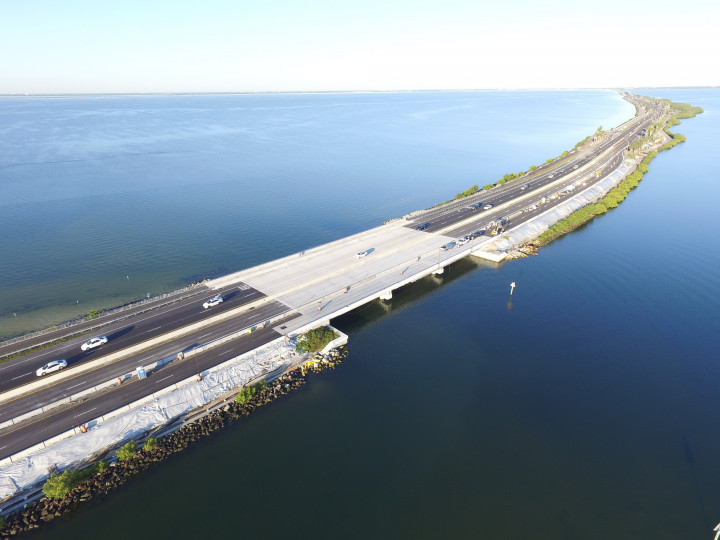
Local evidence demonstrates that interventions to improve circulation have positive impacts on water quality. To mitigate for additional stormwater created when the Howard Frankland Bridge was expanded, a 239-foot bridge was built in 2018 to replace a segment of the eastern Courtney Campbell Causeway. With increased flow came improved water quality that would allow seagrasses to return to approximately 300 acres on the northeastern side of the causeway.
Concentrations of algae that block sunlight from reaching the bay bottom, where seagrasses need it to grow, declined by 82%. FDOT earned environmental awards from the Federal Highway Administration, the American Society of Civil Engineers, and the Tampa Bay Regional Planning Council for the project.
FDOT began studying ways to increase capacity and improve the causeway’s ability to withstand hurricane-force winds and waves earlier this year. Multiple alternatives are being considered, including adding two new lanes, further hardening the causeways, replacing parts of the causeway with culverts or bridges like the 2018 structure, or doing nothing.
Balancing the cost/benefit for the alternatives will be an important consideration, said Kirk Bogen, environmental engineer for District 7, which covers Tampa Bay. “Structures like bridges are typically more expensive than causeways, but we do consider water quality improvements as part of the cost/benefit equation.”
At this point, FDOT is working from a “blank slate,” Bogen said. Public outreach will continue through the summer of 2026 with a public hearing on those plans set for the fall of 2026. Final plans should be completed by the spring of 2027.
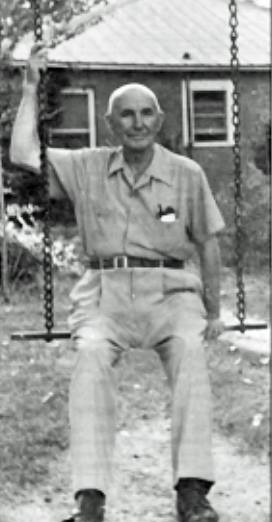
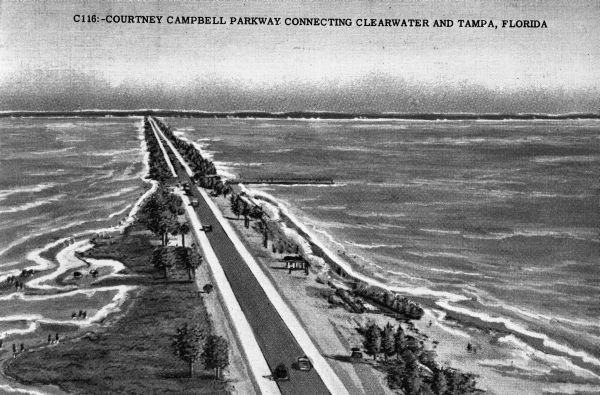
Originally conceived in the 1920s by the owner of a local dredging company named Ben T. Davis, the 9.5-mile causeway was constructed in phases as Davis’s company had time available to work on it. When completed in 1934, it was the longest over-water fill across an open body of water in the US, while two bridges that allow some tidal flow in and out of upper Old Tampa Bay make up less than a mile of the span.
Dredge-and-fill projects like the Courtney Campbell would be nearly impossible to build today as their impact on nearby ecosystems became clear. “You can see the difference in water quality north and south of the causeway, and the local scientific community agrees that these conditions could be significantly improved if water circulation allowed for the natural ebb and flow of tidal waters in the more tidally restricted western sections of Old Tampa Bay,” Sherwood said.
Waterkeeper Tramble concurs. “Our community is coming together to support this effort. It’s a chance for FDOT to check many boxes – safety, efficiency and a positive environmental impact. “We believe that every investment in infrastructure should help the environment, and this is an opportunity for a gigantic win.”
By Vicki Parsons, originally published Sept. 26, 2025